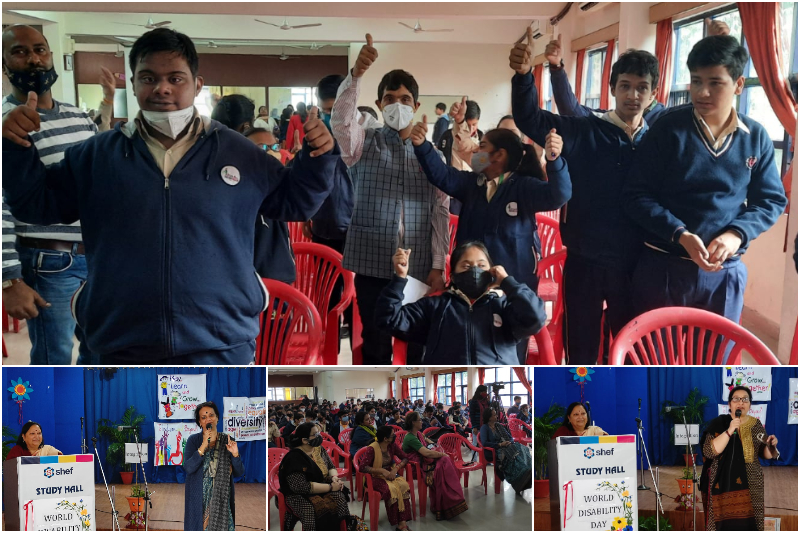
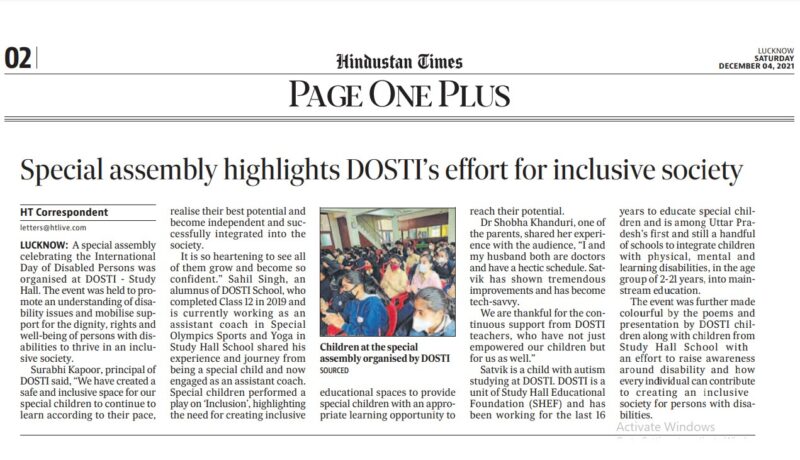
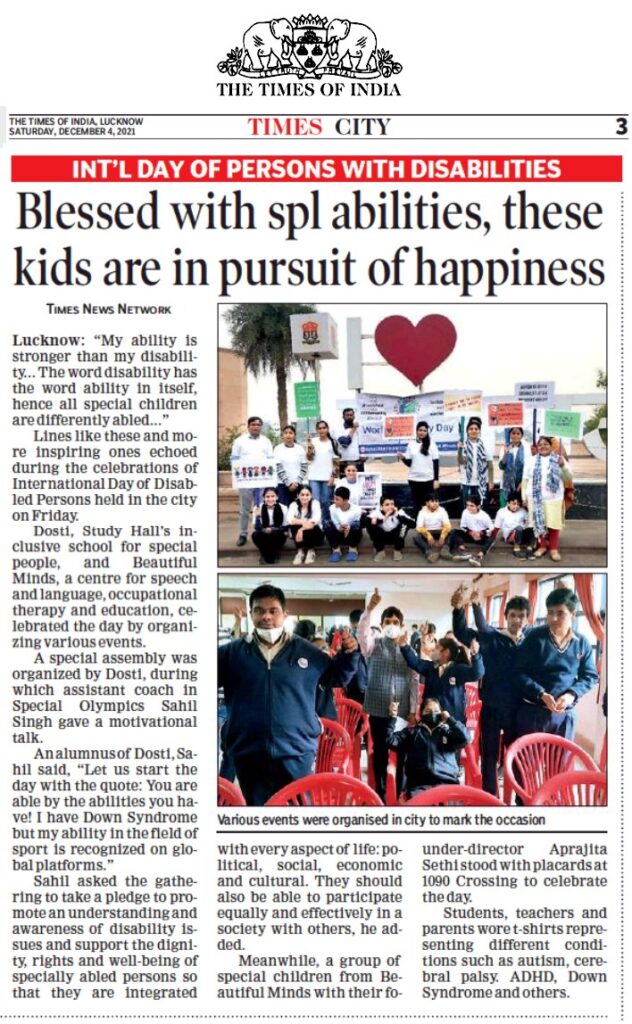
Lucknow: A special assembly celebrating the International Day of Disabled Persons was organised at DOSTI – Study Hall. Surabhi Kapoor, principal of DOSTI said, “I am grateful for all the support I get from the parents and my teachers. Together we have created a safe and inclusive space for our special children to continue to learn according to their pace, realize their best potential and become independent and successfully integrated into the society. It is so heartening to see all them grow and become so confident.”
The event was organised to promote an understanding of disability issues and mobilizing support for the dignity, rights and well-being of persons with disabilities to thrive in an inclusive society.
The event started with a speech by Sahil Singh, an alumn of DOSTI school, who completed class 12 in 2019 and is currently working as Assistant Coach in Special Olympics Sports and Yoga in Study Hall School. Special children performed a play on ‘Inclusion’ highlighting the need for creating inclusive educational spaces to provide special children with an appropriate learning opportunity to reach their potential.
Dr Shobha Khanduri, one of the parents, shared their experience with the audience, “Me and my husband both are doctors and have a really hectic schedule. Satvik has shown tremendous improvements and has become tech savvy. We are thankful for the continuous support from DOSTI teachers, who have not just empowered our children but us as well.” Satvik is a child with Autism studying at DOSTI.
DOSTI is a unit of Study Hall Educational Foundation (SHEF) and has been working for the last 16 years to educate special children and is among Uttar Pradesh’s first and still handful of schools to integrate children with physical, mental and learning disabilities in the age group of 2-21 years into mainstream education.
The event was further made colourful by the poems and presentation by DOSTI children along with children from Study Hall School with an effort to raise awareness around disability and how every individual can contribute to create an inclusive society for persons with disability.
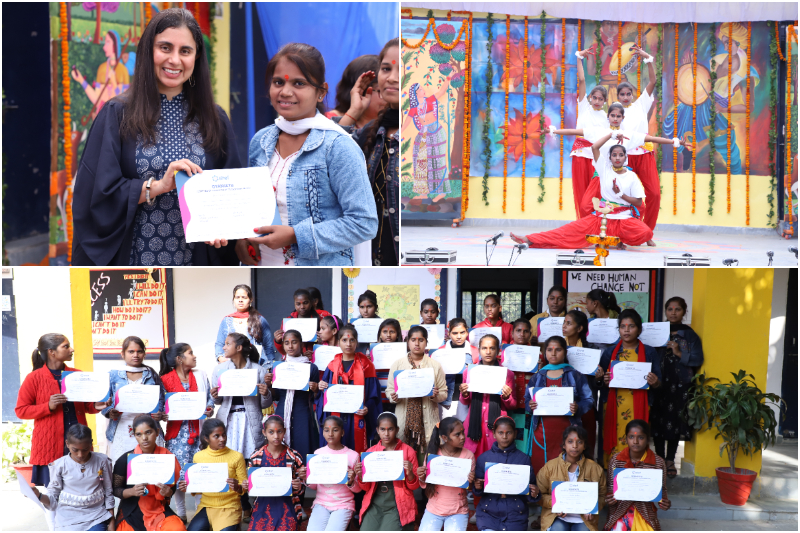
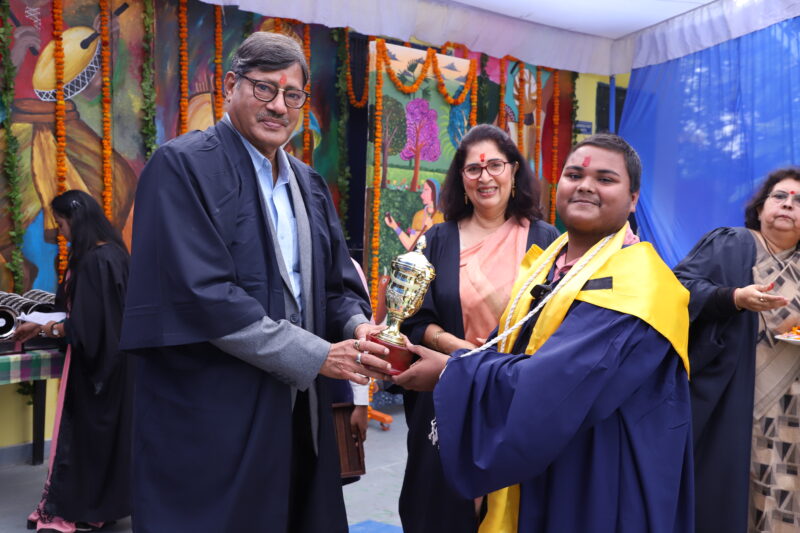
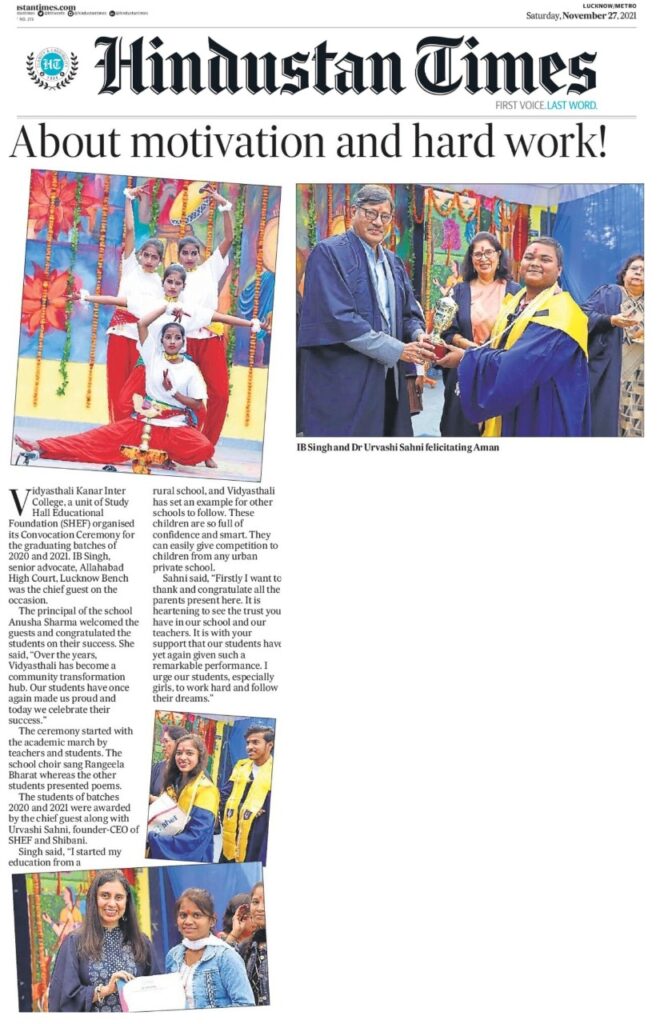
Vidyasthali Kanar Inter College, a unit of Study Hall Educational Foundation (SHEF) held its Convocation Ceremony for the graduating batches of 2020 and 2021. IB Singh, Senior Advocate, Allahabad High Court, Lucknow Bench was the chief guest on the occasion. The principal of the school Anusha Sharma welcomed the audience and congratulated the students on their success. She also added, “Over the years, Vidyasthali has become a community transformation hub. Our students have once again made us proud and today we celebrate their success.”
The ceremony started with the academic procession of teachers and students. The school choir sang Rangeel Bharat along with the students performing poems. The students of batches 2020 and 2021 were awarded by the chief guest, I B Singh, Dr Urvashi Sahni, founder and CEO of SHEF and Shibani Sahni.
Mr I B Singh said, “I started my education in a rural school, and Vidyasthali has set an example for other schools to follow. These children are so confident and smart. They can easily give competition to children from any urban private school. I want to congratulate the principal, the teachers and the students for all the hard work they put in.”
Dr Urvashi Sahni, founder and CEO of SHEF said, “Firstly I want to thank and congratulate all the parents present here. It is heartening to see the trust you have in our school and our teachers. It is with your support that our students have yet again given such remarkable performances. I urge our students, especially girls, to work hard and follow their dreams.”
Priyanshi, an alum of Vidyasthali said, “My school is a universe of care. We are welcomed here with our lives and our problems. After completing my class 12, my family faced a financial crunch and I was unable to continue my higher education. My principal and my teachers supported me and I got a job as a GyanSetu teacher. I am now pursuing my Bachelors in Computer Application from Study Hall College.” Priyanshi also runs digital literacy classes at her GyanSetu center in Nabipanah.
The ceremony also facilitated 38 children who completed their Digital Literacy course at GyanSetu centers. There are 23 GyanSetu centers in and around Malihabad. GyanSetu (a unit of SHEF) centers are small, intimate learning support centers in rural and urban pockets where poverty, gender and caste intersect to prevent children from going to school. Children (predominantly girls) who are out of school and at high-risk of harm go through an accelerated learning program that enables them to enroll in formal schools.
The event ended with the National Anthem and a vote of thanks.
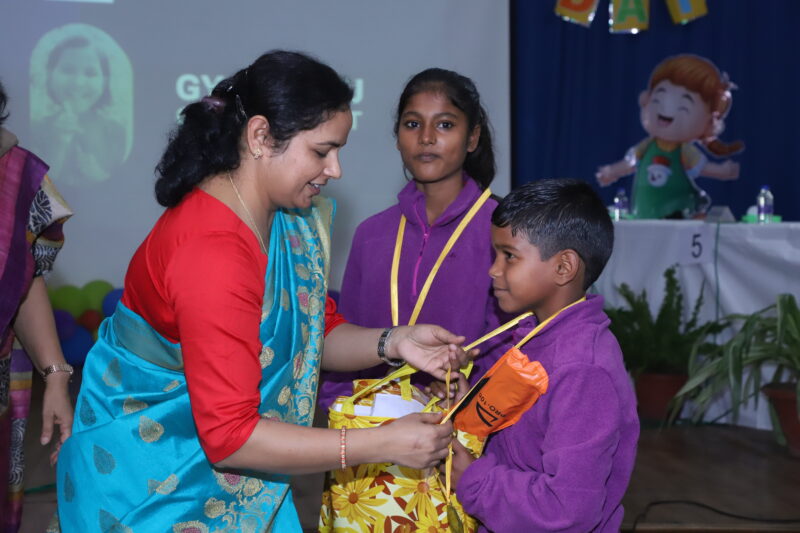
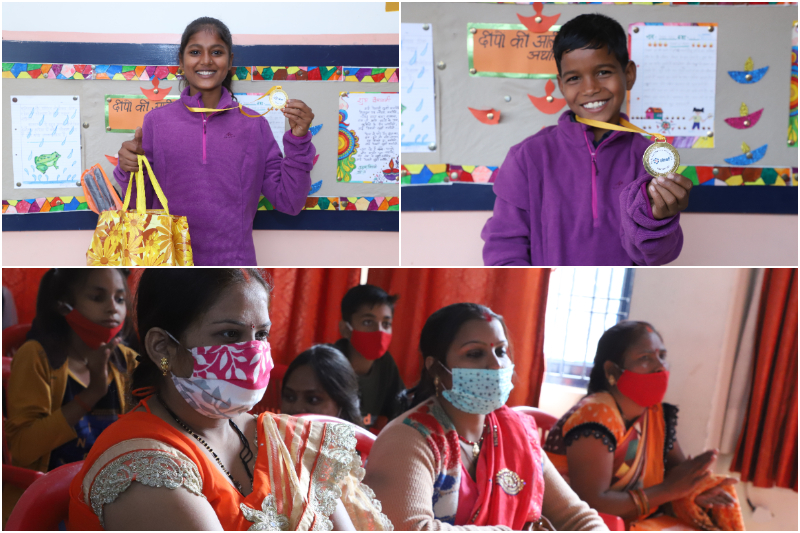
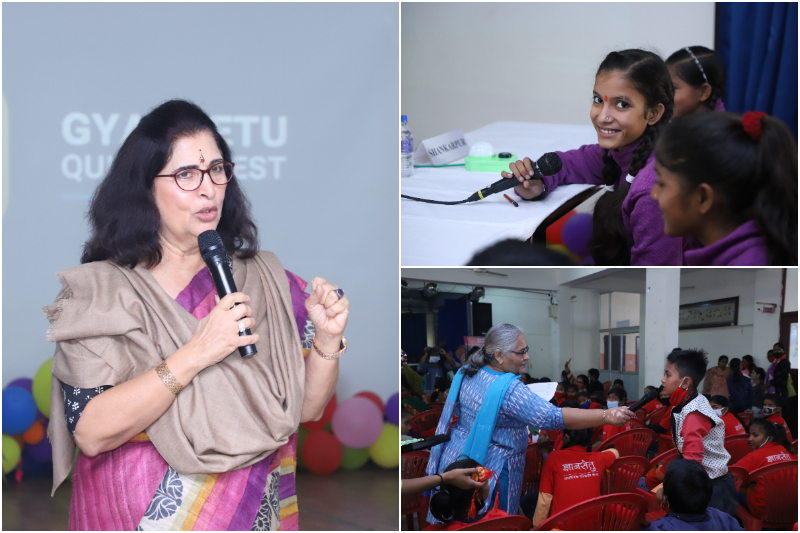
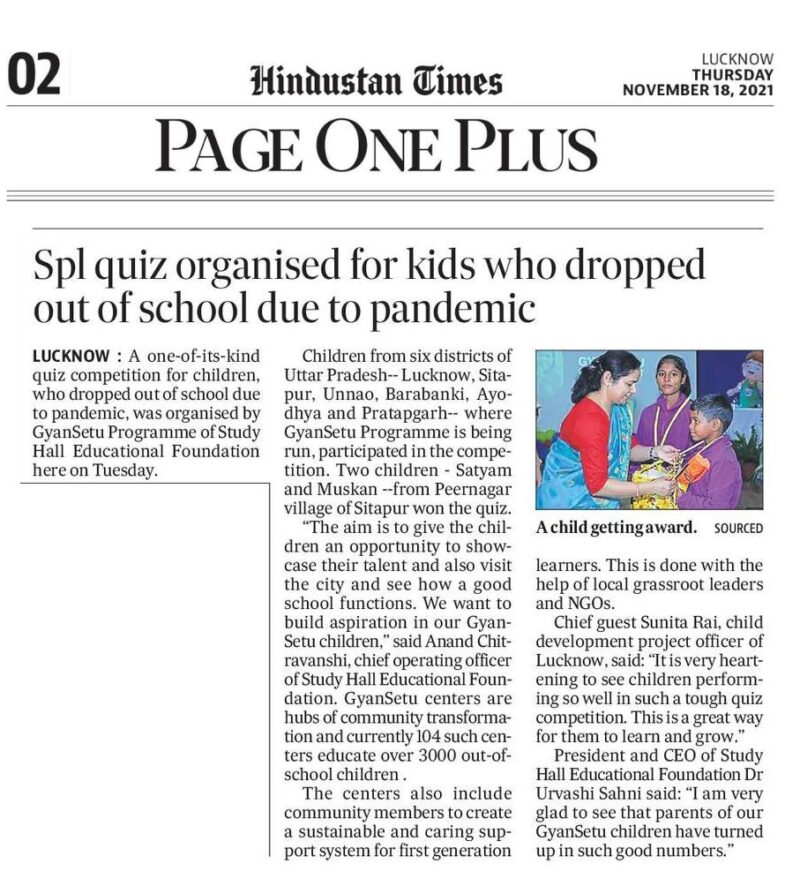
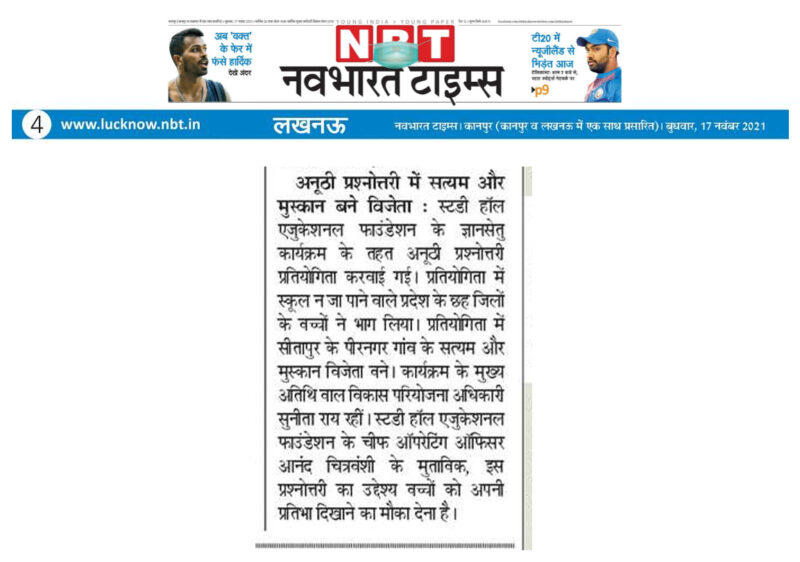
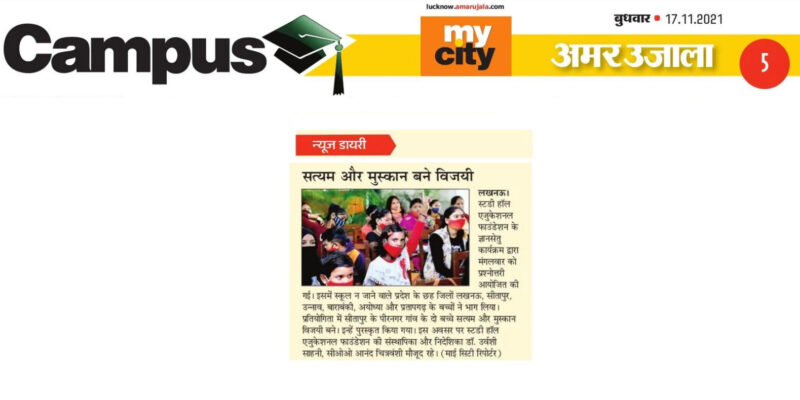
Lucknow: In a one of a kind Quiz Competition – out of school children from six districts of Uttar Pradesh participated and in the end two children – Satyam and Muskan from Peernagar Village of Sitapur emerged as winners.
GyanSetu centers are hubs of community transformation, spread across six districts of Uttar Pradesh – Lucknow, Sitapur, Unnao, Barabanki, Ayodhya and Pratapgarh. Currently 104 such centers educate over 3000 out-of-school children by pacing their learning with an aim to transition them to formal schooling. GyanSetu centers also include community members to create a sustainable and caring support system for first generation learners. This is done with the help of local grassroot leaders and NGOs.
This Quiz Competition was organised by the GyanSetu Program of Study Hall Educational Foundation. The chief guest of the occasion was Sunita Rai, Child Development Project Officer of Lucknow. “It is very heartening to see children performing so well in such a tough quiz competition. This is a great way for them to learn and grow.”
“The aim of this quiz was to give the children an opportunity to showcase their talent and also visit the city and see how a good school functions. We want to build aspiration in our GyanSetu children”, said Anand Chitravanshi, the Chief Operating Officer of Study Hall Educational Foundation.
“I am very glad to see that the parents of our GyanSetu children have turned up in such good numbers. It is very important that we learn to perceive ourselves as equals – man or woman, poor or rich, educated or uneducated – all of us have one vote in our democracy and all of us are equal”, said Dr Urvashi Sahni, President and CEO of Study Hall Educational Foundation. “Our teachers worked really hard with us and we are so happy to make them proud. We have been preparing for the contest since October. My parents and my community will be happy to see us with our winning medals,” said Muskan, student at GyanSetu Peernagar center who won the contest along with Satyam.
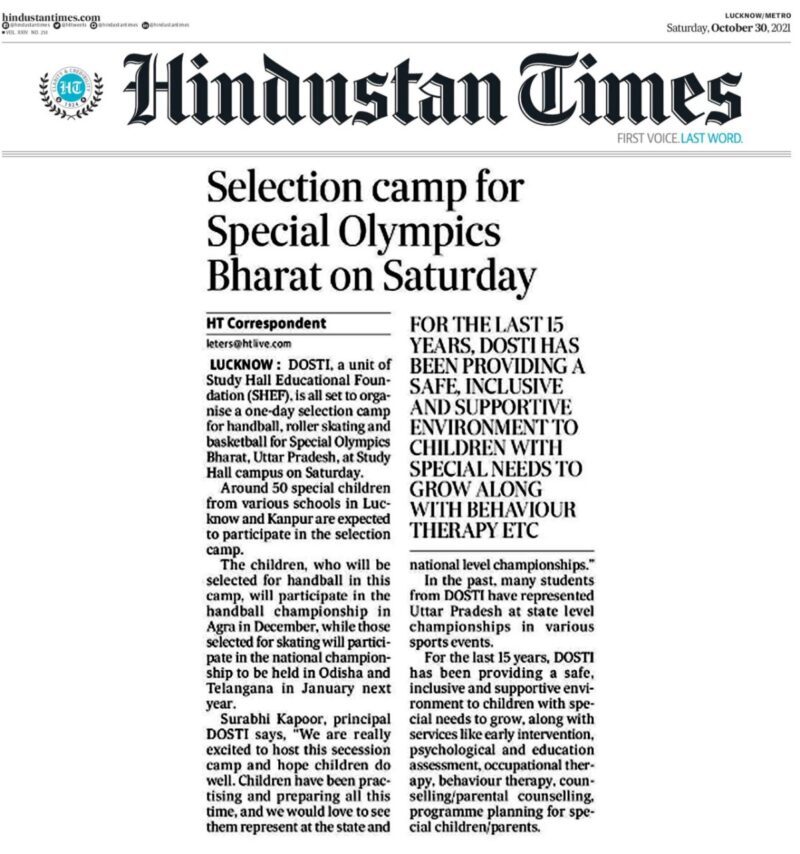
DOSTI, a unit of Study Hall Educational Foundation (SHEF) is all set to organise a one day selection camp of handball, roller skating and basketball for Special Olympic Bharat Uttar Pradesh on Saturday 30.10.21 at Study Hall campus. With a participation of over 50 special children from various schools in Lucknow and Kanpur. The children who will be selected in handball in this camp will be going to Agra in December for the Handball Championship and the children selected for skating will be representing in the National Championship of Skating held in Odissa and Telangana in January. Surbhi Kapoor, principal DOSTI says, “We are really excited to host this secession process and hope children do well. Children have been practicing and preparing all this time and we would love to see them represent at the state and national level championship.” In the past many students from DOSTI have represented Uttar Pradesh at state level championships for various sports events. For the last 15 years, DOSTI has been providing a safe, inclusive and supportive environment to children with special needs to grow, along with services like Early intervention, Psychological and Education assessment, Occupational Therapy, Behaviour Therapy, Counselling/parental counselling, Programme planning for special children/parents. DOSTI was founded in 2005, is among UP’s first and very few schools to integrate children with physical, mental and learning disabilities in the age group of 2-21 years into mainstream education.
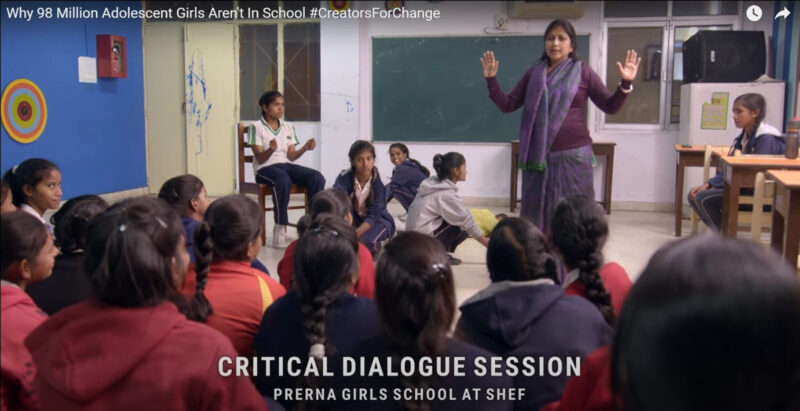
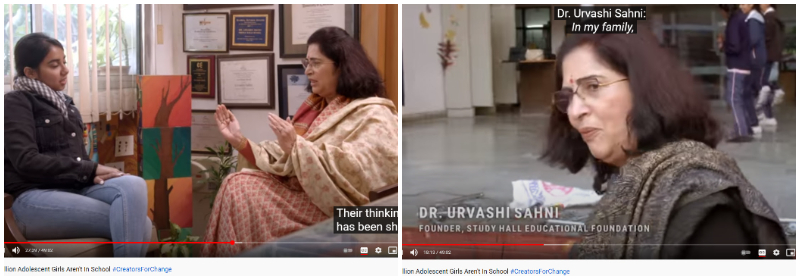
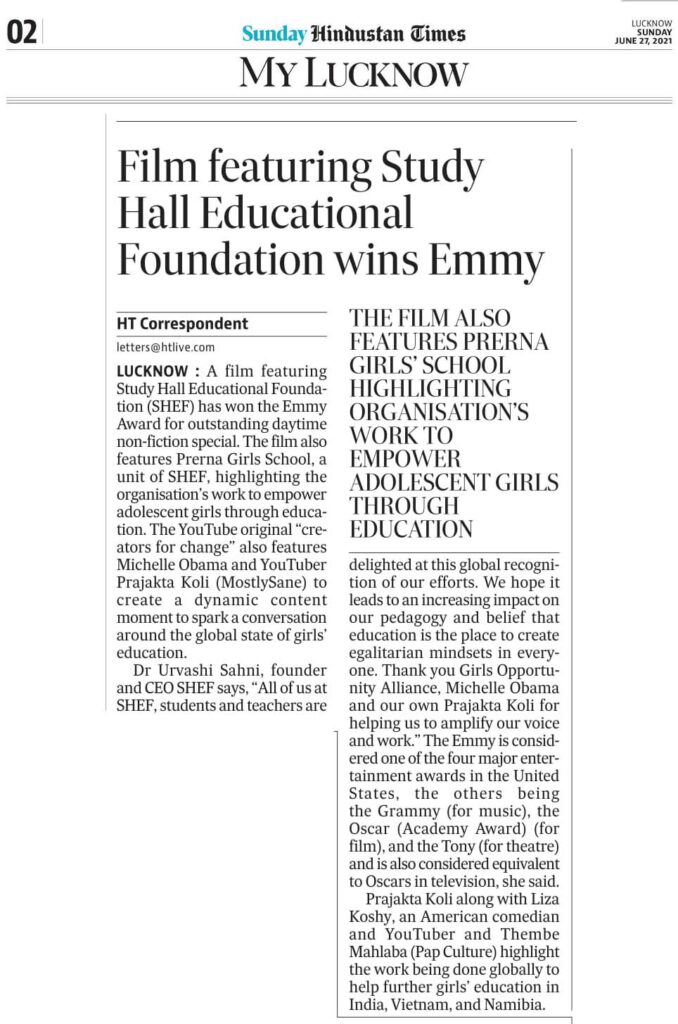
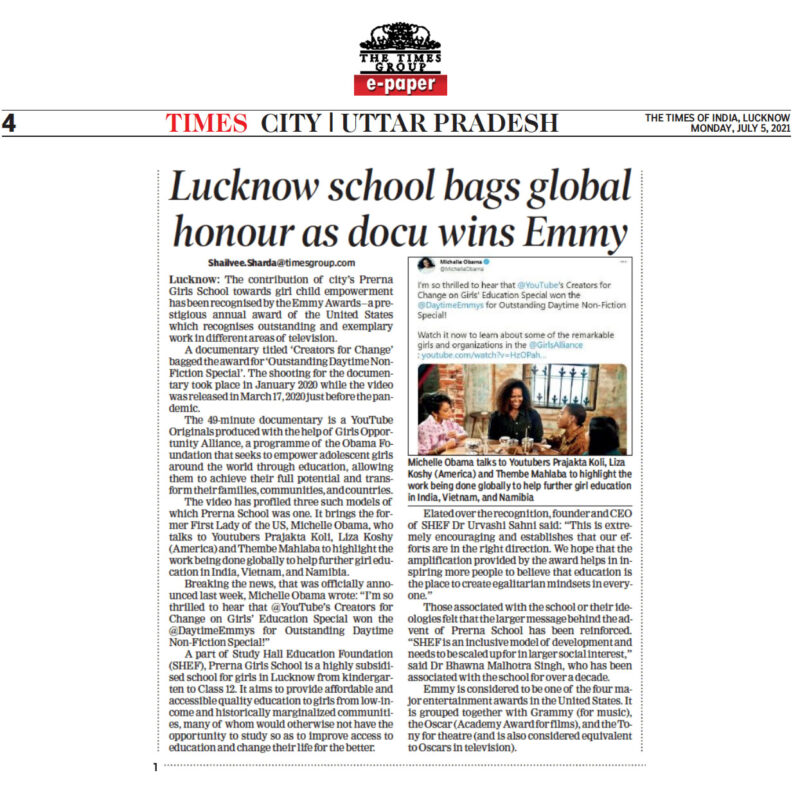
A film featuring Study Hall Educational Foundation has won the prestigious Emmy Award for Outstanding Daytime Non-Fiction Special. The film features Prerna Girls School, a unit of SHEF and highlights the organization’s work to empower adolescent girls through education. The YouTube Originals “Creators For Change” also features Michelle Obama and YouTuber Prajakta Koli (MostlySane) with the aim to create a dynamic content moment to spark a conversation around the global state of girls’ education.
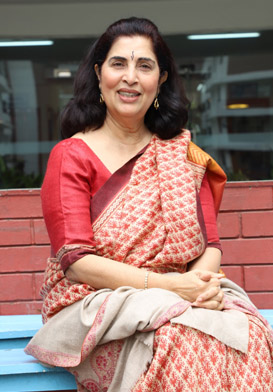
Dr Urvashi Sahni, Founder and CEO SHEF says, “All of us at Shef, students and teachers are delighted at this global recognition of our efforts! We hope it leads to an increasing impact of our pedagogy and belief that education is the place to create egalitarian mindsets in everyone! Thank you Girls Opportunity Alliance, Michelle Obama and our own Prajakta Kohli for helping us to amplify our voice and work!”
The Emmy is considered one of the four major entertainment awards in the United States, the others being the Grammy (for music), the Oscar (Academy Award) (for film), and the Tony (for theatre) and is also considered equivalent to Oscars in Television.
Prajakta Koli along with Liza Koshy, an American comedian and YouTuber and ThembeMahlaba (Pap Culture) highlight the work being done globally to help further girls’ education in India, Vietnam, and Namibia.
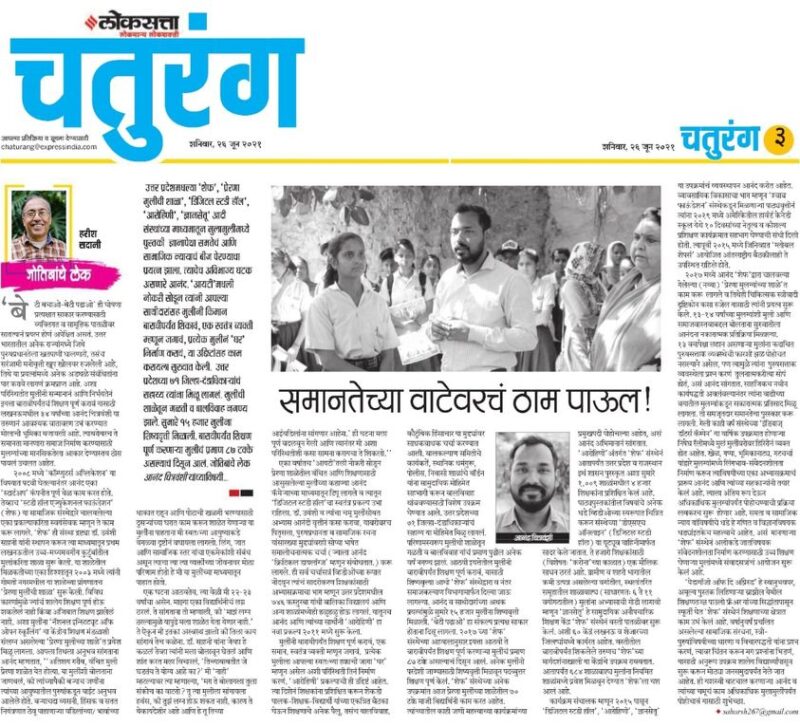
Our Director of Programs, Mr Anand Chitravanshi featured in an article by Chief Functionary of Men Against Violence & Abuse, Mr Harish Sadani in ‘Loksatta’, Marathi newspaper as a part of his fortnightly column, featuring Men of Substance from across India. The article talks about how Mr Anand Chitravanshi has been instrumental in building gender sensitivity with a critical feminist lens among adolescent boys, enabling them to be a ‘part of the solution’ to the gender problems in Northern India.
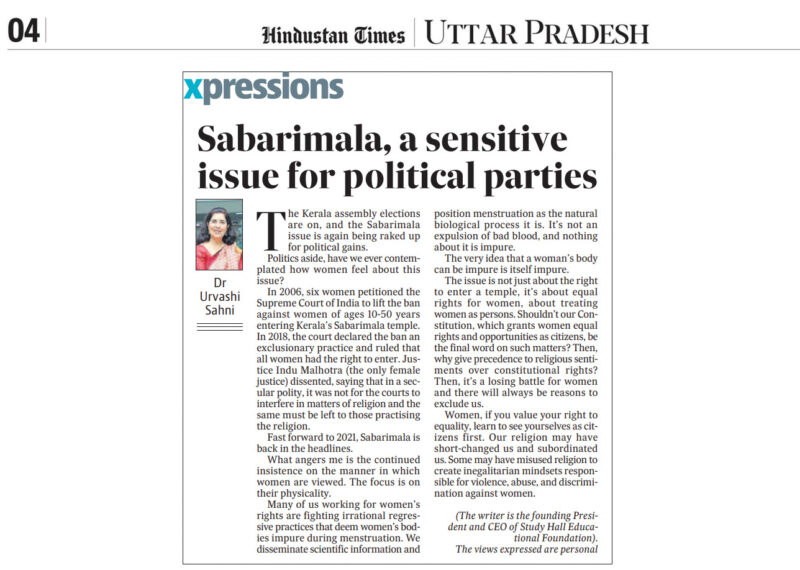
In 2006, 6 women members of the Indian Young Lawyers Association, petitioned the Supreme Court of India to lift the ban against women between the ages of 10 and 50 entering the Sabrimala Temple in Kerala. They argued that the practice was a violation of their constitutional rights and questioned the validity of provisions in the Kerala Hindu Places of Public Worship ( Authorisation of Entry) Rules act of 1965. They won as the Supreme Court ruled in 2018 that women of all age groups can enter Sabarimala Temple. The court ruled thus: We have no hesitation in saying that such an exclusionary practice violates the right of women to visit and enter a temple to freely practice Hindu religion and to exhibit her devotion towards Lord Ayappa. The denial of this right to women significantly denudes them of their right to worship. The verdict was passed with a 4-1 majority. The only female judge, Justice Indu Malhotra dissented. – saying that every individual should be allowed to practice their faith irrespective of whether the practice is rational or logical.
As we know there was resistance to this judgement and a petition to review the judgement was made. On 14th November 2019, the Supreme court Constitution Bench referred the review petitions as well as the writ petitions to a larger bench of not less than seven judges. This review is still pending as there is a difference of opinion even on the decision to review the petition.
The Congress party which claims to be a secular party has now raked up the issue again by promising to make such “violations of tradition” a cognizable offence!! This is clearly an effort to win over the Hindu voters in Kerala.
What angers me as it did Bindu Ammini, the first woman of menstruating age to enter Sabarimala on 2nd January 2019, is the continued insistence on viewing women as bodies and not persons. How does a person become impure? When do men become impure? When do they lose their izzat? Many of us working for women’s rights are also fighting against irrational and regressive practices of considering women’s bodies impure during menstruation, imposing a quarantine on them during this time. We are doing our best to disseminate scientific information about menstruation and positioning it as a natural biological process in women’s bodies, which should be celebrated because it signals the onset of fertility in women. That nothing about it renders her impure, and that women do not expel bad blood from their bodies during menstruation, that it is as natural as any other bodily process.
While we are trying to dispel myths and superstitions regarding menstruation, rescuing their person hood from objectification as bodies, learned women like Justice Indu Malhotra are supporting these very myths!!! Maybe she too needs to be part of our menstrual hygiene awareness camps. The very idea that a woman’s body can be impure is a repulsive impure idea. When and under what circumstances may I ask, is a man’s body rendered impure? Would we declare a rapist man’s body impure for instance? So that he may not enter Durga devi’s temple? Which religious tradition excludes a savarna man, however impure and repulsive his deeds from any temple? For dalit men of course the story is different. They are deemed to be rendered impure by their caste and so seem to warrant exclusion. Again a despicable, impure practice!
Furthermore, shouldn’t our constitution which grants women equal rights and opportunities as a citizen, be the final word on such matters? If we continue to give precedence to religious sentiment over constitutional rights, then women are fighting a losing battle and there will always be reasons to exclude them, to consider them less, impure etc. it is our constitution and our citizenship that grants us equal rights, not our religions – any religion. So Sisters – if you value your right to equality, that many of your sisters fought for, then learn to look at yourselves as citizens first and last, not as Hindu, Muslim or Christian women. Our religions have always short changed us, constructed a perception of us as unequal, subordinate, imposed sexist norms of chastity on us, which men are exempt from and created the inegalitarian mindsets that are responsible for so much violence, abuse and discrimination against women, which has been normalized, naturalized and which receives spoken and unspoken social sanction.
The issue is not just about having the right to enter a temple, it is about equal rights for women, about treating women as persons, about refusing to accept a label of being ‘impure’ at any stage or age of our lives.
Finally – it is about time that women who make up 50% of the countries electorate, start demanding that issues of their safety in their home, on their streets and in their mothers wombs be taken seriously by political parties seeking their vote. Indian women are unequal, unsafe, unwanted and unfree in free India! While Congress is rushing to make barring women entry in Sabarimala an election issue, I don’t see it or any party making women’s safety, right to free mobility, to equality, to inclusion being made an election issue. Women are still waiting for the 33% reservation in Parliament – this inclusion of women has not been seen as deserving to become an election issue for any party, while exclusion of women has!
Celebrating the unique gifts Autistic children are born with, we are sharing stories of significant progress made by children with Autism at DOSTI school. DOSTI is a unit of Study Hall Educational Foundation (SHEF), that has been working for the last 16 years to educate special children. DOSTI is among Uttar Pradesh’s first and still handful of schools to integrate children with physical, mental and learning disabilities in the age group of 2-21 years into mainstream education.
April 2 is recognised as World Autism Day and observed annually. Autism causes impairment in development, communication skills and social interaction and is difficult to diagnose before 24 months of age.
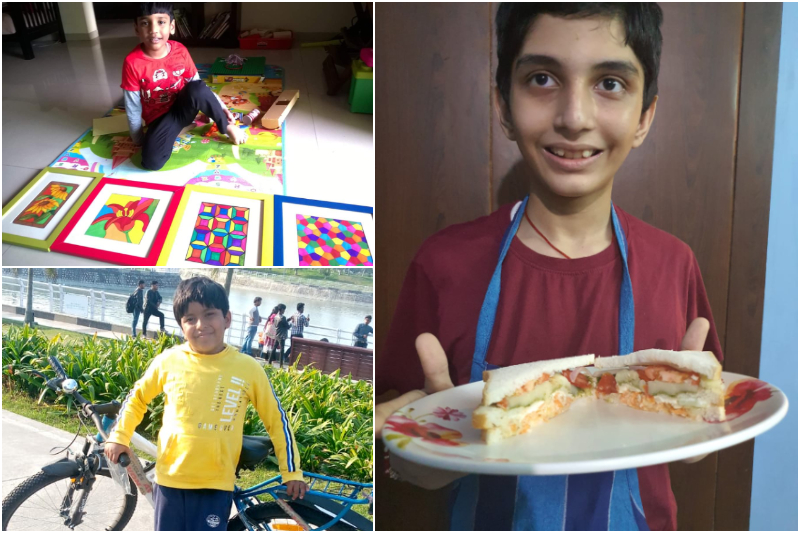
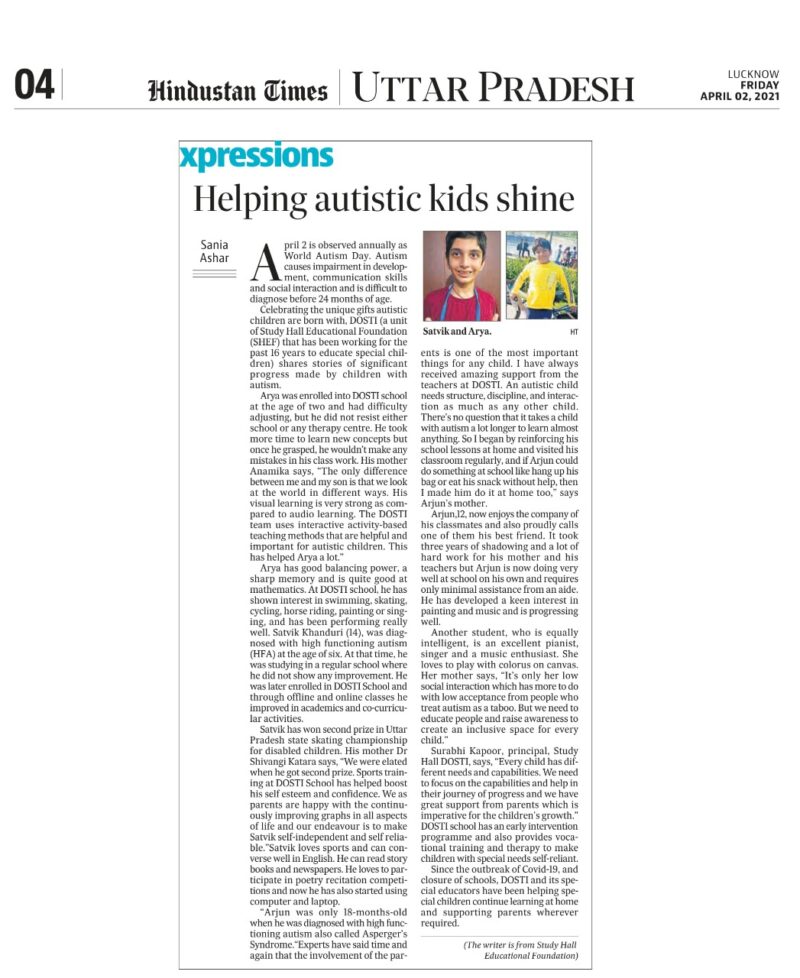
Arya was enrolled into school at the age of two where he had difficulty adjusting, but he never opposed going to school or any therapy center. He used to learn new concepts with more time but once he grasped, he wouldn’t make any mistakes in his class work. His mother Anamika says, “The only difference between me and my son is that we look at the world in different ways. His visual learning is very strong as compared to audio learning. The DOSTI team uses such interactive activity-based teaching methods that are helpful and important for Autistic children. This has helped Arya a lot.” She also adds “A child with a different ability uncovers strengths and abilities in you that you never knew you had. Having Arya has made me a stronger and wiser person and I no longer sweat on the small stuff. Perhaps I am the right person that is why God gifted me Arya.
Aarya has good balancing power, a sharp memory and is quite good at mathematics. At DOSTI school, he has shown interest in swimming, skating, cycling, horse riding, painting or singing, and has been performing really well.
Surabhi Kapoor, principal, Study Hall DOSTI, says “Every child has different needs and capabilities. We need to focus on the capabilities and help in their journey of progress and we have great support from our parents which is imperative for the child’s growth.” DOSTI school has an early intervention program and also provides vocational training and therapy to make children with special needs self
reliant.
Satvik Khanduri (14), was diagnosed with High Functioning Autism (HFA) at the age of six. At that time, he was studying in regular school where he did not show any improvements. He was later enrolled in DOSTI School, and through offline and online classes he improved in academics and co-curricular activities. Satvik has won second prize in Uttar Pradesh State skating championship of disabled children. Dr Shivangi katara, Satvik’s mother says, “We were elated when he got second prize. Sports training at DOSTI School, has been a great booster of self esteem and confidence and was a turning point in Satvik’s life. We as parents are happy with continuously improving graphs in all aspects of life and endeavour is to make Satvik self-independent and self reliable.”
Satvik loves sports and can converse well in English and can read story books and newspapers. He loves to participate in poetry recitations competitions. And now he has also started using computers and laptops.
“Arjun was only 18-months-old when he was diagnosed with high functioning Autism also called Asperger’s Syndrome. “Experts have said time and again that the involvement of the parents is one of the most important things for any child. I have always received amazing support from the teachers at DOSTI. But school can only do so much with the time they have. An autistic child needs structure, discipline, and interaction as much as any other child. There’s no question that it takes a child with autism a lot longer to learn almost anything. So I began by reinforcing his school lessons at home and visited his classroom regularly, and if Arjun could do something at school like hang up his bag or eat his snack without help, then I made him do it at home, too,” says Arjun’s mother.
Arjun (12) now enjoys the company of his classmates and also proudly calls one of them his “best friend. It took 3 years of shadowing and a lot of hard work for his mother and his teachers that Arjun is now doing very well at school on his own and requires only minimal assistance from an aide. He has developed a keen interest in painting and music and is progressing well.
He is mostly independent during activities and has an IEP designed by his remedial therapist and me.
The parent requests anonymity
Another student from DOSTI, who is equally intelligent if not more like any other kid of her age. She is an excellent pianist, singer and a music enthusiast. She loves to play with colors on canvas. Her mother, “It’s only her low social interaction which is more to do with low acceptance from people and society around, who treats autism as a taboo. But we need to educate people and raise awareness to create an inclusive space for every child. These kids have one or other special skills which God has blessed them with and as any parents we just need to identify their interest and help them live their passion.”
Since the outbreak of the COVID19 pandemic and the closure of schools, DOSTI and its special educators have been helping special children continue learning at home and supporting parents wherever required.
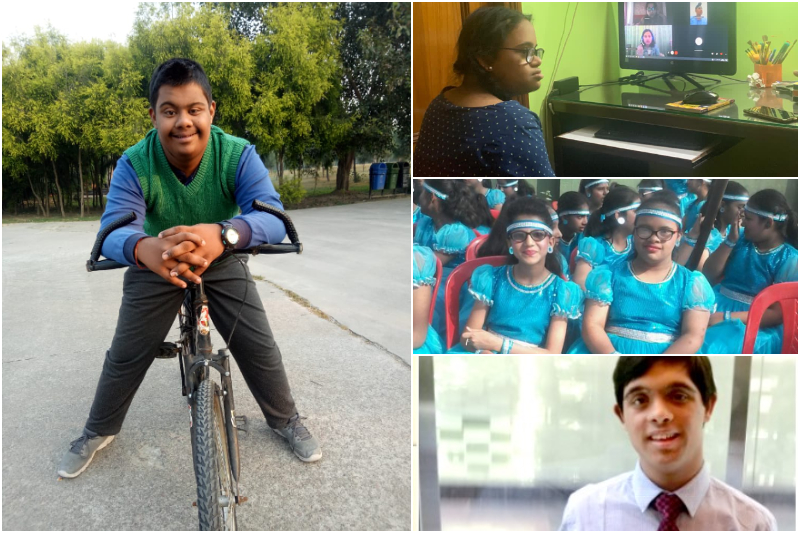
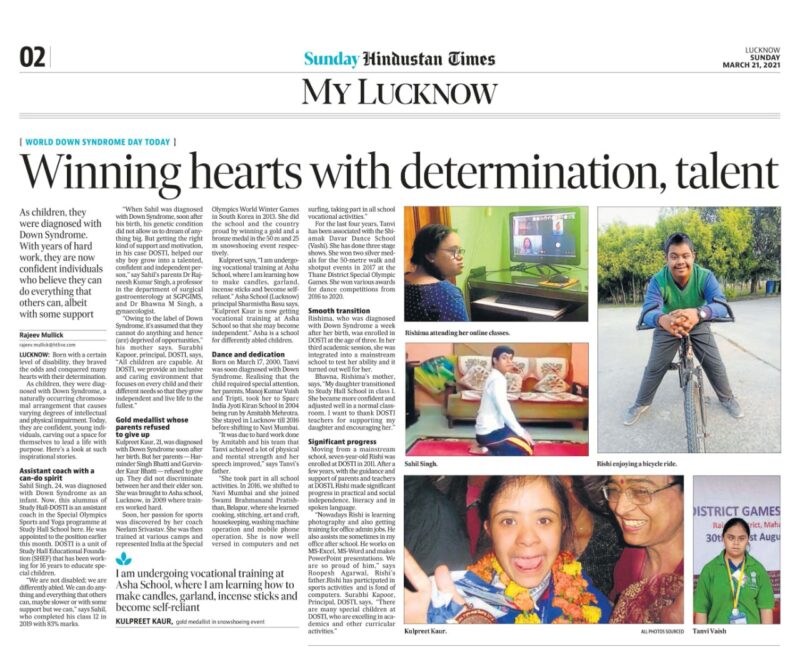
With the right kind of support children with Down Syndrome can excel and achieve their dreams. Meet Sahil, Rishima and Rishi, children with Down Syndrome who have proved that they can’t be stopped.
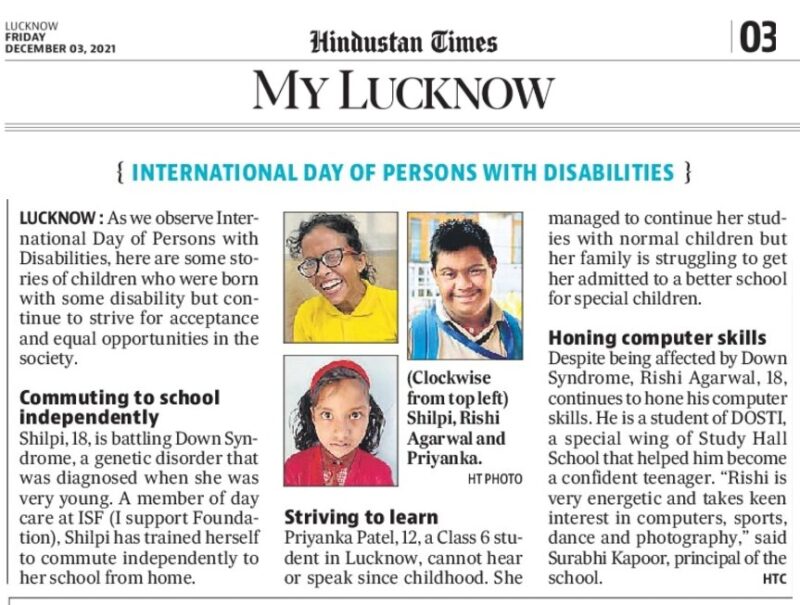
Sahil (24), an alum of Study Hall – DOSTI was appointed as assistant coach at Study Hall School earlier this month. DOSTI, a unit of Study Hall Educational Foundation (SHEF), that has been working for the last 16 years to educate special children. DOSTI is among Uttar Pradesh’s first and still handful of schools to integrate children with physical, mental and learning disabilities in the age group of 2-21 years into mainstream education. Surabhi Kapoor, Principal, DOSTI, says, “All children are able and capable. At DOSTI, we provide an inclusive and caring environment that focuses on every child and their different needs so that they grow independent and live life to the fullest.” Like Rishima, Sahil and Rishi, there are many special children at DOSTI, who are excelling in academics and other curricular activities with the support of teachers and parents. DOSTI has an early intervention program and also provides vocational training and therapy to make children with special needs self reliant. March 21, is a global awareness day observed as the World Down Syndrome Day. Down Syndrome is a naturally occurring chromosomal arrangement. It can cause varying degrees of intellectual and physical impairment.
Sahil says, “We are not disabled, we are differently abled. We can do anything and everything that others can, maybe slower or with some support but we can.” Sahil, who suffers from Down Syndrome, completed his class 12 in 2019 with 83% and was appointed as the Assistant Coach in Special Olympics Sports and Yoga at Study Hall School earlier this month. “When Sahil was diagnosed with down syndrome 24 years back, his genetic condition did not allow us to dream of such an achievement. But getting the right kind of support and motivation, in his case DOSTI, helped our shy and introverted boy grow into a talented, confident and independent person,” says Sahil’s mother, Dr Bhawna.
Providing support and helping children with special needs, Rishima, who was diagnosed with Down Syndrome one week later after her birth was enrolled in DOSTI at the age three. In her third academic session, she was integrated into a mainstream school to test her ability and it turned out well for her. Bhavna, Rishima’s mother says, “My daughter transitioned to Study Hall School in class 1, she became more confident and adjusted well in a normal classroom. I want to thank DOSTI teachers for supporting my daughter and encouraging her.” Moving from a mainstream school, seven-year-old Rishi was enrolled at DOSTI in 2011. After a few years, with the guidance and support of parents and teachers at DOSTI, Rishi made significant progress in practical and social independence, literacy and in spoken language. “Nowadays Rishi is learning photography and also getting training for office admin jobs. He also assists me sometimes in my office after school. He works on MS-Excel, MS-Word and makes PowerPoint presentations. We are so proud of him,” says a very happy Roopesh Agarwal, Rishi’s father. Rishi has participated in different sports activities of Special Olympic Bharat and is fond of computers.
 DONATE
 WORK WITH US



 Volunteer
