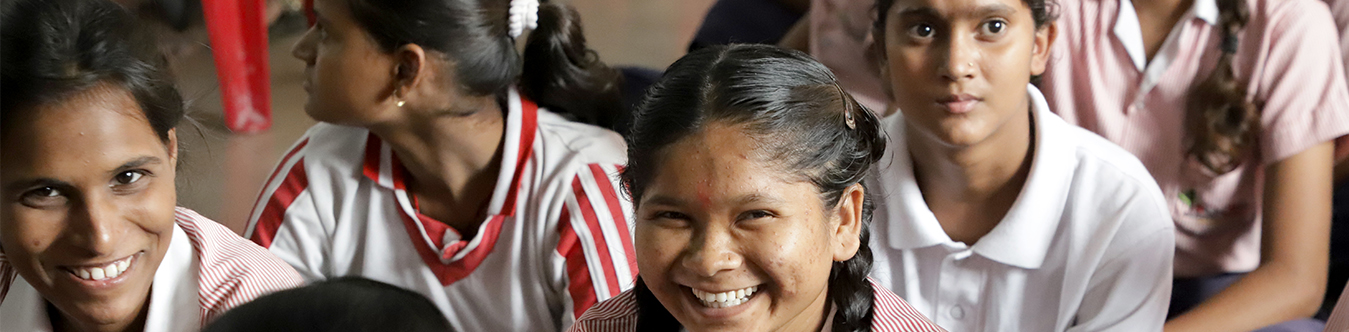
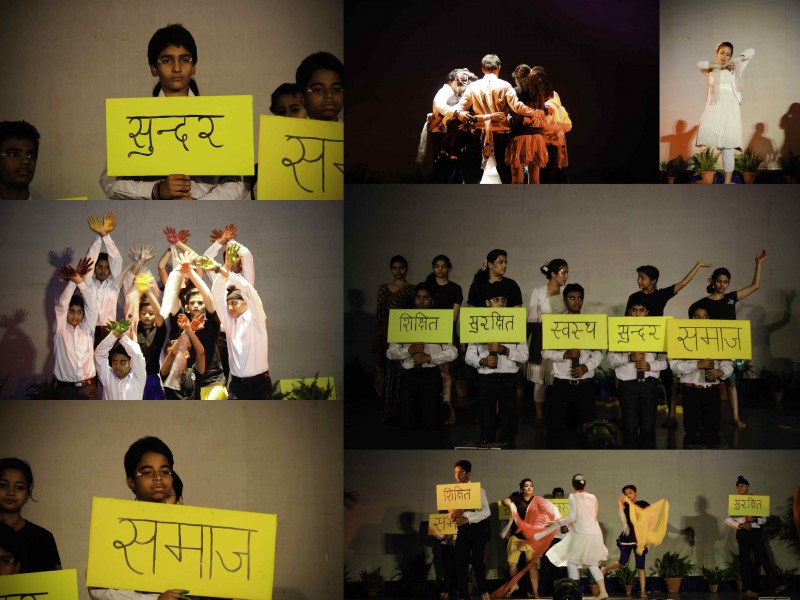
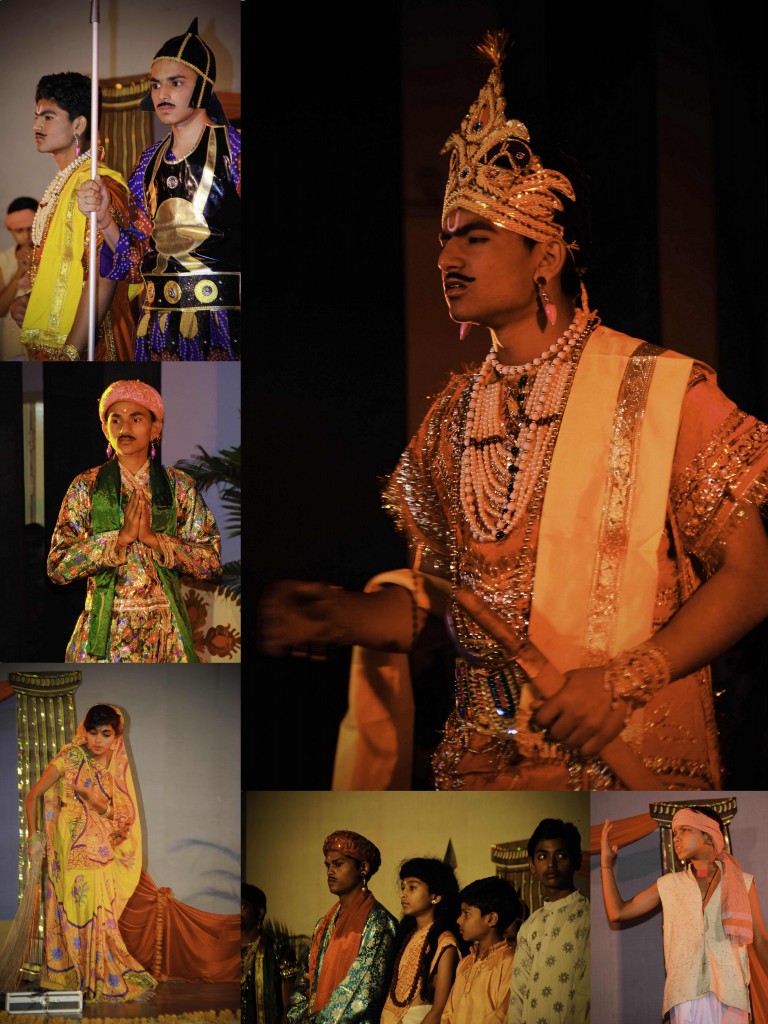
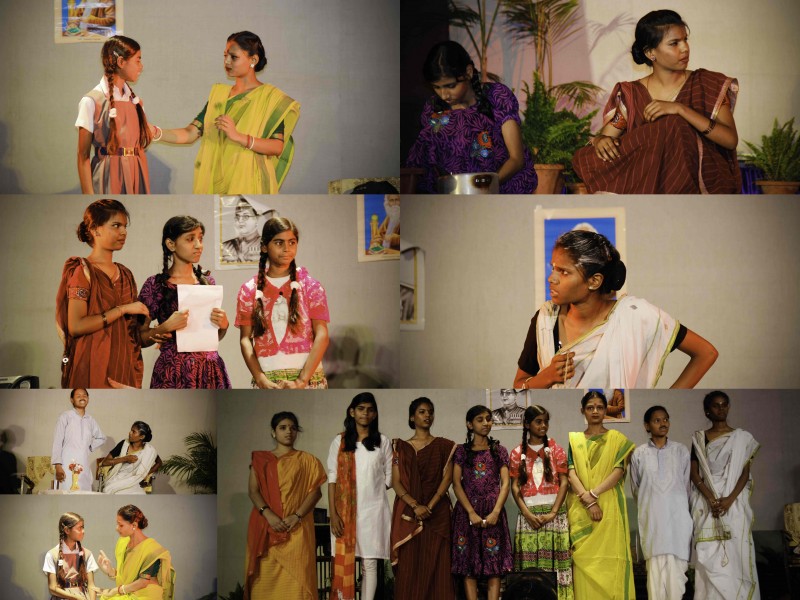
Prerna girls raised the issue of child labor through this play based on a Bengali story. Inspired by her teacher, the school going, pampered daughter of a well to do family raises a storm and finally manages to convince her parents and the mother of the servant girl that all girls have a right to study. The girl’s acting was superb and a Bengali home was beautifully recreated on the stage.
Yuva Manch 2015 Ganit Raja
Natyautsav, a presentation by Yuva Manch – a platform for promoting theatre among students, was held at Tourism Bhawan on 9th May, 2015.
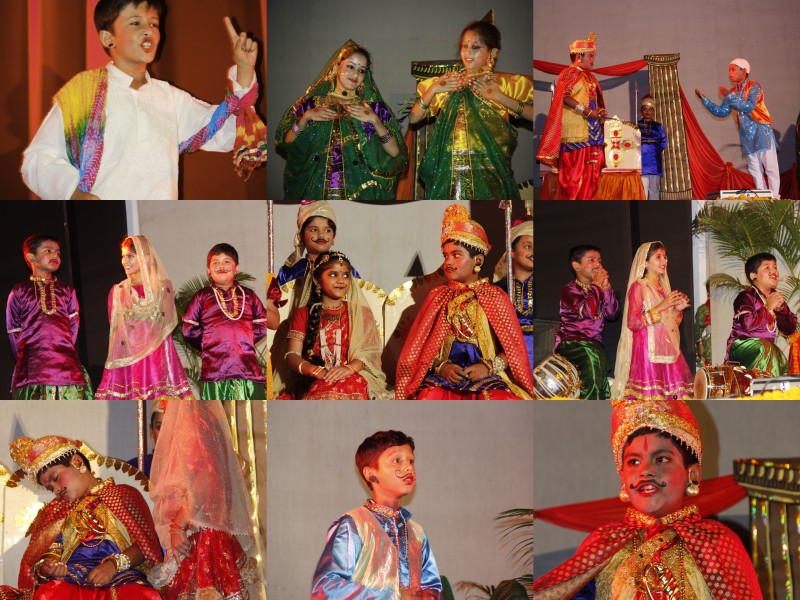
Dosti, the wing for children with special needs presented a hilarious play about “Ganit Raja.” Divit Verma performed with confidence and won the hearts of the audience. The rest of the performers also put in their best efforts and had the audience identifying with the theme: the significance of numbers in every aspect of life.
Amusing turns and twists took the story line forward with a happy ending sealing the deal the main character, Pratham, makes with ‘Ganit Raja’. The parents and other guests enjoyed the delightful presentation.
.
Natyotsav 2015 Yuva Manch

amarujala my city - 10th may 2015
युवा मंच बॉल मंच समाहित 2015 “नाट्योत्सव”दिनांक 9 , 10 मई 2015 को स्टडी हॉल फाउंडेशन की विभिन्न शाखाओं द्वारा उत्तर प्रदेश पर्यटन भवन के सभागार में दो दिवसीय “नाट्योत्सव” कार्यक्रम का आयोजन किया गया । यह कार्यक्रम अत्यंत भव्य था । दर्शक बच्चों के अभिनय क्षमता से प्रभावित हुए बिना नहीं रह सके ।
Curtain Raiser Natyautsav
“Yuva Manch is a theater group started by Study Hall Educational Foundation, Several schools and alumni participate in several theater productions featured at Yuva Manch. This year Yuva Manch brings forth productions from Study Hall School, Prerna Girls School, DOSTI School and Vidyasthali School through U.P Tourism auditorium, Gomti Nagar”
‘Natyotsav’, a presentation by ‘Yuva Manch’, our platform for promoting theater among students.
We look forward to your presence and encouragement.
Venue: Uttar Pradesh Paryatan Bhawan ,Gomti Nagar , Lucknow.
Date: 9th & 10th May, 2015
Time: 5:00 pm
Natyotsav Programme Order ( 9th May,2015)
|
5:00 pm to 5:10 pm |
Introduction |
|
5:10 pm to 5:25pm |
Ganit Raja ( Play by Dosti) |
|
5:25pm to 5:45pm |
Dushman koi Nahin( Play by Vidyasthali) |
|
5:45pm to 6:10pm |
Thodi Thodi Aur Bajegi( Play by Junior School) |
|
6:20pm to 7:00pm |
Main Gandhari ( Play by Alumni & students of Senior School) |
|
7:00pm to 7:10pm |
Dance Drama( by CFL students) |
|
7:10pm to 7:20 pm |
Principal’s Address |
Natyotsav Programme Order ( 10th May, 2015)
|
5:00pm to 5:10pm |
Introduction |
|
5:10pm to 5:30pm |
Haan Zindagi Badlegi ( Play by Prerna Girls School) |
|
5:30pm to 5:40pm |
Izzat ( Dance Drama by Prerna Girls School) |
|
5:40pm to 5:50pm |
Song ( by Prerna Girls – filler) |
|
6:00pm to 6:40pm |
Main Gandhari( Play by Alumni & students of Study Hall) |
|
6:40pm to 6:50pm |
Dance Drama ( by students of CFL) |
|
6:50pm to 7:00pm |
Urvashi Aunty’s Address & Certificates |
|
7:00pm to 7 :10pm |
Vote of Thanks by Principal |
Prerna Girls at Poetry of Purpose Book Launch
Prerna girls were invited to perform a musical presentation at the book launch of Poetry of Purpose, a book coauthored by Mick Minard and Dr. Shashi Gogate. Poetry of Purpose is a portrait of women leaders of India and features Dr. Urvashi Sahni’s as one of the leaders.
A FAILED SCHOOL SYSTEM – FAILING INDIA’S CHILDREN

Authored by
Dr. Urvashi Sahni
President and Chief Executive Officer
Study Hall Educational Foundation
The Delhi high courts verdict upholding the conviction of former chief minister of Haryana O.P. Chautala and others complicit with him in recruiting 3000 teachers after false interviews is very very heartening! Perhaps there is a ray of hope for the broken government school system. Pratham’s ASER report has been showing us every year, that children in our primary schools are NOT learning! Less than 50 % of Grade 5 children can read a Grade 2 text. They are not learning because the teachers do not attend school and when they do they teach for less than half the time they are there. What is even more shocking, this is no secret to the department, but they do nothing about it. To quote Justice Siddharth Mridul who said in his judgement that teachers who are “inducted through patronage, nepotism and corruption cannot morally, be higher than the methods that produced it and be free from the sins of its own origin.” Thank you sir! This is exactly the point. The poor performance of our children is not a pedagogical issue to be fixed by more teacher training, it is a governance issue, a corruption issue, which can only be fixed by stern action of the kind taken by the courts. No government has been successful in ensuring that teachers attend regularly and teach their students! The whole school system has been shamelessly politicised and corrupted. The only achievement of the government school system with over 300 billion rupees spent on it, seems to be the employment of over a million teachers. That these teachers deliver no results seems to be of no interest to the Government. Even a 10 years jail sentence is too little for the double defrauding that has happened! Firstly the tax payer has been defrauded by a misuse of her hard earned tax money, but even sadder and more criminal is the defrauding of innocent children, who have the right to an education.
Unless we demonstrate a strong political will by paying attention to the corruption of the school system and the entire education machinery – the administrative staff, the teachers and the politicians, ALL criminally complicit in defrauding India’s children by their apathy, neglect and corrupt commissions and omissions, the country is headed for disaster. More than 70% children are served by the government school system or so they should be. Right now all studies tell us that only a small fraction (42%) of the children who enrol in Grade 1 finish high school.
Governments are terrified of the teacher unions, who threaten to withdraw political support if any action is taken against the teachers. So they do nothing even though they know that a large number of teachers do not attend school even though they are paid very well! I have spoken to IAS officers to ministers and even Chief Ministers. None of them have an answer to this problem! Like with everything else, everyone seems to have given up in the face of corruption. Just something we have to live with? I think not.
The failed school system must either deliver, or stop pretending. The right to education is an empty promise when there is no political will to take the necessary steps needed to fulfil it. When politicians are more interested in the votes teachers will deliver than the children whose learning they should be nurturing, when teachers are more concerned about secure, permanent jobs, with very little accountability than the work they are being paid for, when the administrative staff has no interest in the children and their learning, so taken up are they with teacher transfers and postings, then why are we surprised that our children are failing? The question to ask though, is WHO IS FAILING -THE CHILDREN OR OUR SCHOOL SYSTEM? For how long will a rotted, corrupt system stand and continue the pretence of educating our children?
This article was also published in Hindustan Times News Paper, Lucknow Edition
H1N1- AWARENESS PROGRAMME
Dr. Nikhil Singh conducted an awareness programme for the staff and students of the school on the precautionary measures to be taken to prevent the spread of H1N1 inFLUenza,commonly known as swine flu.During the session he enlightened everyone with the origin, spread, symptoms and protection available for the control of this virus.
Criteria for Admission in Various Streams
| Science Stream for CBSE | ELIGIBILITY |
| PCM | Overall Grade A1, A2 8.5-10 |
| Maths/Science A1, A2 Non Upgraded | |
| PCB | Overall Grade A1, A2,B1 8.0 and above |
| Maths/Science B1 Non Upgraded | |
| SCIENCE Stream for ICSE | ELIGIBILTY Best Five |
| PCM | Overall Grade 85%
Maths 85% |
| PCB | Overall Grade 80%
Maths+Science 80% |
| Commerce Stream For CBSE with Maths | Overall Grade 7.5and above (Maths) |
| Maths A1, A2 8.5 and above | |
| Commerce Without MATHS for CBSE
COMMERCE STREAM FOR ICSE WITH MATHS
COMMERCE STREAM FOR ICSE without MATHS |
Overall Grade 7.0 and above
MATHS B1 OVERALL GRADE 75% MATHS 80%
OVERALL GRADE 70% MATHS 80% |
| Humanities for CBSE | Overall Grade 7.0 and above |
| English A1, A2 8.5 and above | |
|
HUMANITIES FOR ICSE |
Social Science A1, A2 8.5 and above
OVERALL GRADE 75% ENGLISH 85% SOCIAL SCIENCE 85%
PNote: I hereby promise to abide by the above mentioned criteria for admission laid by the school for XI session 2015-2016 |
ADMISSION FOR CLASS XI SESSION 2015-2016
Primary Education in India: Progress and Challenges

Authored by
Dr. Urvashi Sahni
The Second Modi-Obama Summit: Building the India-U.S. Partnership
In recent decades India has made significant progress on access to schooling and enrollment rates in primary education but dropout rates and low levels of learning remain challenges for the state and central government. As the U.S. has a longer history of public education than India there are opportunities for India to learn from the successes and failures in the American education system and to collaborate in tackling shared challenges, such as the best use of technology in primary education.
Primary school enrollment in India has been a success story, largely due to various programs and drives to increase enrolment even in remote areas. With enrollment reaching at least 96 percent since 2009, and girls making up 56 percent of new students between 2007 and 2013, it is clear that many problems of access to schooling have been addressed. Improvements to infrastructure have been a priority to achieve this and India now has 1.4 million schools and 7.7 million teachers so that 98 percent of habitations have a primary school (class I-V) within one kilometer and 92 percent have an upper primary school (class VI-VIII) within a three-kilometer walking distance.
Despite these improvements, keeping children in school through graduation is still an issue and dropout rates continue to be high. Nationally 29 percent of children drop out before completing five years of primary school, and 43 percent before finishing upper primary school. High school completion is only 42 percent. This lands India among the top five nations for out-of-school children of primary school age, with 1.4 million 6 to 11 year olds not attending school. In many ways schools are not equipped to handle the full population – there is a teacher shortage of 689,000 teachers in primary schools, only 53 percent of schools have functional girls’ toilets and 74 percent have access to drinking water.
Additionally, the quality of learning is a major issue and reports show that children are not achieving class-appropriate learning levels. According to Pratham’s Annual Status of Education 2013 report, close to 78 percent of children in Standard III and about 50 percent of children in Standard V cannot yet read Standard II texts. Arithmetic is also a cause for concern as only 26 percent students in Standard V can do a division problem. Without immediate and urgent help, these children cannot effectively progress in the education system, and so improving the quality of learning in schools is the next big challenge for both the state and central governments.
Improving learning will require attention to many things, including increasing teacher accountability. According to school visits teacher attendance is just 85 percent in primary and middle schools and raising the amount of time teachers spend on-task and increasing their responsibility for student learning also needs improvement. Part of this process requires better assessments at each grade level and more efficient monitoring and support systems. Overall, the public school system also needs a better general management system.
India also faces many challenges that could be tackled through the education system. For one gender issues have come to the fore because of the spate of recent cases of violence against girls. Changing gender mindsets seems to be imperative and gender studies education is one way of doing so. Also India, along with most countries, is concerned with the future of the labor market and employability; Prime Minister Mr. Narendra Modi wants to emphasize skill development in order to make school education more practically relevant.
Areas of Collaboration
Many of India’s concerns about education are shared by the U.S., such as ensuring quality, improving teacher capabilities, effective use of technology, and improving management systems. The US and India can achieve better learning outcomes if they pool their experience and resources – both intellectual and economic.
1. Leveraging technology
Both the U.S. and India are looking for solutions to provide high-quality learning opportunities to marginalized students. Technology has a lot of potential to improve education but how it can be implemented most effectively and in the case of India, most cost-effectively, still remains a question. There are several initiatives in India, by NGOs, like the Azim Premji Foundation & Digital Studyhall, and corporations like ILFS, Educom, Intel, Medialabs, to mention just a few, in content creation, teacher training and classroom learning. So far philanthropists and incubators are the ones who have helped to identify and scale best practices. A more officially driven effort is required to evaluate digital content and even more importantly to develop cost effective methods of making these available to teachers and students in areas where resources are scarce. Prime Minister Modi has shown a keen interest in this area, mentioning the need for ‘digital classrooms’ several times in his speeches in India and abroad. Given the issues of scale in terms of numbers and geography, which India needs to tackle in order to reach all her children and make sure they are learning effectively, technology definitely has an important role to play. The U.S. and India could collaborate and work to understand together how technology might be leveraged to improve student learning, teacher training, monitoring and support, management of schools and the quality of learning, especially in remote districts. The U.S. already has much experience in providing technology to schools and India could learn from its successes and failures. Furthermore, collaboration with the U.S. could help promote research in this area and build the evidence base in India.
2. Teacher education
The lack of learning in India’s schools call for changes to teacher education. A collaboration between American universities’ schools of education with Indian teacher training institutes could help build capacity and upgrade teacher education both in terms of curriculum and pedagogy, which is much needed in Indian teacher education institutions like the District Institutes of Education and Training. Such collaborations could be facilitated through technology, collaborative research projects, teacher exchanges, and subsidized online courses for teachers in India by universities in the United States.
3. Building good assessment systems
Good assessments are useful at the classroom level for teachers to gauge their students’ understanding and also to inform policy. The need for regular and useful assessments in India is something that Indian departments of education are focusing on at the central and state level. The U.S. could share lessons learned on how to make assessments as effective as possible in terms of assessment design, implementation and management of data.
4. Gender studies education
The state of women in India has recently drawn a lot of attention and promoting gender equality through education has an important role to play. Boys and girls should be taught to think about gender equality from an early age and the curriculum should include gender studies with appropriate teacher training. The U.S. could share its experiences of promoting gender equality through schools and help advance both action and research.
5. Skills Development
As making education more practically relevant to the labor market is a priority for Prime Minister Modi, there is much India can learn from experiences in the United States. A shared agenda of helping identify and implement improved ways to develop skills and competencies even at the school level could be an important area for collaboration.
6. Resources
Currently spending on education is low in India, and stands at 3.4 percent of the GDP. The U.S. might be able to help make it more of a priority, and nudge the government to increase spending on education.
Originally posted at India-U.S. Policy Memo, The Brookings Institution
DONATE
WORK WITH US


Volunteer